Views: 0 Author: Site Editor Publish Time: 2026-06-26 Origin: Site

Operating commercial and industrial freezers below -30°C exposes the structural limits of standard refrigeration equipment. System failures at these extreme temperatures do not just risk operational downtime. They result in catastrophic product loss and severe compliance breaches. Facility managers and engineers constantly battle these operational risks. They must also transition to low-GWP refrigerants and adhere to stricter energy regulations. During this transition, single-stage compressors increasingly fail to meet required compression ratios. They simply cannot sustain these ratios without sacrificing equipment longevity. Upgrading to a 2-stage architecture addresses the root causes of thermal degradation and efficiency loss. This technical guide breaks down how these advanced units perform. We explore how to evaluate their financial returns correctly. Finally, we highlight where they become structurally necessary for decision-stage buyers prioritizing reliability. Understanding this engineering shift protects your capital investments and safeguards your temperature-sensitive inventory.
You must understand the core problem facing deep-freeze applications. Pushing a single-stage unit from a -40°C evaporating temperature to a +40°C condensing temperature creates massive thermal stress. We define the compression ratio by dividing absolute discharge pressure by absolute suction pressure. In this scenario, the ratio often exceeds 15:1. Most standard single-stage compressors only operate safely up to a 10:1 ratio. Beyond this threshold, the mechanical effort required to compress the refrigerant vapor increases exponentially. The system works much harder but moves significantly less heat. This physical limitation creates a bottleneck for any ultra-low temperature facility.
Extreme compression ratios generate dangerous operational risks. High discharge temperatures literally "cook" the compressor oil. When discharge temperatures exceed 150°C, typical synthetic and mineral oils carbonize. They lose their critical viscosity. This thermal degradation destroys the oil's lubricating properties. Without proper lubrication, internal friction spikes rapidly. You will eventually face catastrophic valve failures or seized bearings. Maintenance teams often discover dark, sludgy oil during routine checks. This sludge indicates active thermal breakdown inside the system. Replacing damaged compressors frequently drains facility budgets and halts production schedules.
Volumetric efficiency plummets as the compression ratio climbs. High pressure forces residual gas to remain inside the cylinder clearance volume. This high-pressure gas re-expands during the suction stroke. Consequently, the actual amount of fresh refrigerant pumped drops severely. The compressor must run for much longer periods to achieve the same cooling effect. These continuous running cycles inflate your monthly energy bills. The equipment experiences premature wear. You pay more money for electricity while receiving less actual refrigeration capacity. Upgrading the system architecture becomes the only logical engineering response.
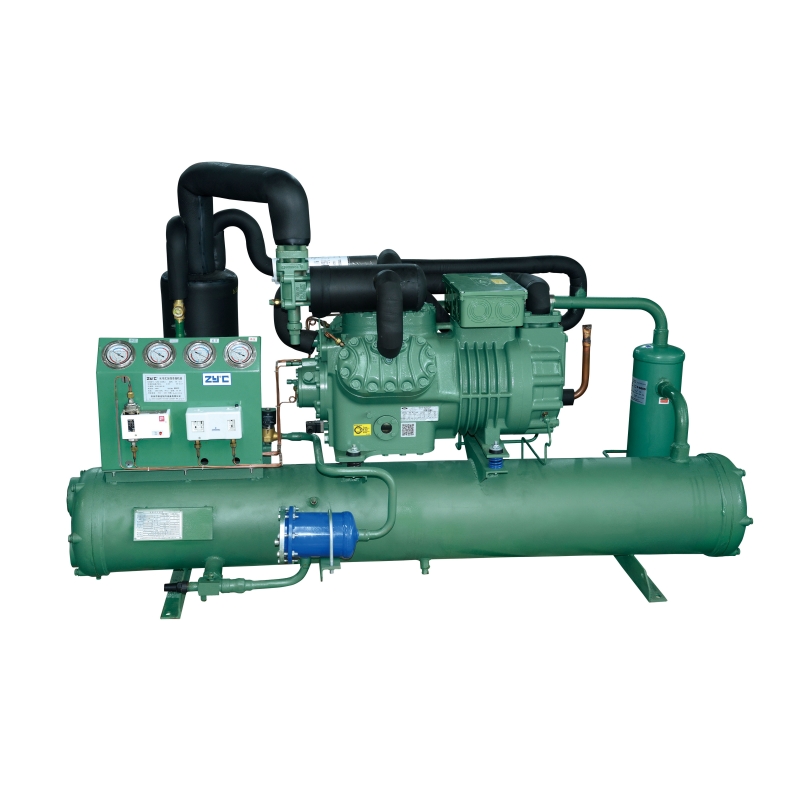
Splitting the compression process solves the physics problem entirely. A modern Semi-Hermetic Reciprocating Compressor Condensing Unit divides the workload into low-pressure (LP) and high-pressure (HP) stages. Both stages exist within a single semi-hermetic casing. This intelligent design halves the mechanical burden on individual cylinders. The LP cylinders draw in the low-pressure vapor from the evaporator. They compress it to an intermediate pressure. Then, the system routes this gas to the HP cylinders for final compression. Dividing the ratio prevents the discharge temperature from reaching dangerous levels.
The intercooling stage serves as the heart of a 2-stage system. This component provides critical temperature control between the LP and HP stages. We rely on this process to maximize cooling capacity.
This sequence increases the enthalpy difference across the evaporator. You directly yield more cooling capacity per kilowatt of electricity consumed. The subcooling effect guarantees high efficiency.
Engineers consistently choose semi-hermetic reciprocating designs over alternatives. Fully hermetic compressors represent unrepairable, throwaway technology. If an internal component fails, you must scrap the entire unit. Scroll compressors offer excellent efficiency at medium temperatures. However, they face strict capacity limits in low-temperature environments. Semi-hermetic reciprocating units provide field-rebuildability. Technicians can open the casing to replace valve plates, pistons, or stators. This repairability protects your long-term capital investment. You do not need to replace heavy machinery when minor components wear out over time.
Facility managers must analyze equipment costs through a long-term lens. Buyers generally face a 20-30% higher initial cost for a 2-stage unit compared to a single-stage alternative. However, you must frame this initial CapEx against a 5-year lifecycle analysis. The OpEx savings quickly justify the upgrade. Two-stage systems draw significantly less energy to maintain deep-freeze temperatures. They also require fewer emergency service calls because they operate within safer thermal limits. The break-even point typically occurs within two to three years of continuous operation.
Coefficient of Performance (COP) dictates your true energy expenditure. Buyers should explicitly request COP curves from manufacturers. You need to compare single-stage versus 2-stage performance at your specific design ambient and room temperatures. At -35°C evaporating temperatures, a single-stage unit might struggle with a COP of 0.8. A 2-stage unit operating under identical conditions can easily achieve a COP of 1.2 or higher. This represents a massive leap in energy efficiency. Over thousands of operational hours, these decimal differences translate into tens of thousands of dollars saved.
| Parameter | Single-Stage System | 2-Stage System |
|---|---|---|
| Discharge Temperature | Dangerously High (>130°C) | Controlled & Stable (<90°C) |
| Volumetric Efficiency | Low (High re-expansion) | High (Optimized stages) |
| Oil Degradation Risk | Severe (Requires frequent changes) | Minimal (Oil retains viscosity) |
| Average COP | Lower (High energy penalty) | Higher (Superior energy usage) |
Modern package designs simplify installation procedures. Previous generations of 2-stage systems required extensive custom field piping. Today, advanced condensing units arrive pre-integrated. Manufacturers pre-pipe the intercooler, liquid receiver, and complex oil management systems at the factory. This modularity reduces the overall footprint in crowded mechanical rooms. It also drastically eliminates field piping errors. Installers save valuable labor hours. You gain a cleaner, more reliable system layout right out of the box.
The industry is rapidly shifting toward A2L and natural refrigerants to meet environmental mandates. Many new low-GWP refrigerant blends exhibit inherently higher discharge temperatures. This characteristic makes single-stage compression even more risky. Semi-hermetic reciprocating designs adapt perfectly to these new discharge profiles. The intercooling stage neutralizes the thermal spikes associated with low-GWP blends. Upgrading to a 2-stage architecture ensures your facility remains compliant with future regulations. You future-proof your refrigeration infrastructure against changing chemical standards.
Healthcare supply chains demand uncompromising precision. Medical facilities store blood plasma, sensitive vaccines, and critical bio-samples at ultra-low temperatures (ULT). These environments tolerate zero temperature fluctuations. A single-stage thermal overload could ruin millions of dollars of irreplaceable medical supplies. Two-stage units provide the stringent temperature tolerances required. They deliver the continuous, fail-safe cooling necessary to maintain pharmaceutical efficacy. Their stable operation eliminates the unacceptable risk of sudden mechanical failure.
Industrial food processors rely heavily on rapid thermal management. Blast freezing and Individual Quick Freezing (IQF) require immediate temperature pull-down. Freezing food slowly creates large ice crystals. These crystals pierce cellular walls, ruining food texture and moisture content upon thawing. Two-stage systems deliver the massive instantaneous cooling capacity needed. They freeze products rapidly to lock in nutritional value and product weight. They protect the processor's bottom line by maintaining premium food quality.
Industrial manufacturing and aerospace sectors require rigorous component testing. Environmental test chambers simulate extreme high-altitude or sub-arctic conditions. These chambers execute rapid thermal cycling from positive to extreme sub-zero temperatures. Single-stage compressors cannot survive these violent pressure shifts. Two-stage architectures handle rapid cycling effortlessly. They pull temperatures down to -50°C quickly and reliably. Automotive and electronics manufacturers depend on this equipment to validate product safety before public release.
Many contractors hold a dangerous misconception. They believe "bigger is always better" when sizing low-temperature equipment. Over-sizing a 2-stage unit creates severe operational headaches. An oversized compressor satisfies the thermostat too quickly. This leads to chronic short-cycling. The compressor turns on and off constantly. Short-cycling prevents the system from establishing proper mass flow. It severely disrupts oil return mechanisms and burns out motor contactors. You must size the equipment precisely to match the calculated heat load. Proper sizing ensures long, stable run times.
Low-temperature refrigeration presents unique lubrication challenges. At extremely low mass-flow rates, returning oil from the evaporator becomes physically difficult. The dense cold vapor struggles to carry oil droplets back up the suction line. You must prioritize precise oil management. Installers must properly pitch all horizontal piping to assist gravity return. Furthermore, you must integrate high-efficiency oil separators at the compressor discharge. These separators strip oil from the hot gas before it travels to the condenser. Returning oil directly to the crankcase prevents mechanical seizing.
You cannot pair advanced compressors with outdated controls. Realizing the maximum efficiency gains of a 2-stage setup requires modern electronics. Legacy mechanical thermostatic expansion valves (TXVs) react too slowly for intermediate cooling stages. You must install precise electronic expansion valves (EEVs). EEVs monitor superheat continuously and adjust refrigerant flow in real time. Additionally, you should deploy advanced capacity control modules. These digital controllers sequence the compressor stages flawlessly. They optimize performance across widely varying ambient conditions.
Upgrading your low-temperature infrastructure is a vital strategic decision. Two-stage semi-hermetic condensing units are never a luxury for deep-freeze applications. They remain an absolute engineering necessity. They proactively counteract the destructive physics of high compression ratios. By splitting the mechanical workload, these systems eliminate oil carbonization and restore volumetric efficiency. They protect temperature-sensitive inventory while slashing monthly energy consumption.
Decision-makers must take immediate action. First, audit your current low-temperature maintenance logs. Look for patterns of frequent oil changes, sludge buildup, or recurring valve replacements. These symptoms indicate failing single-stage systems. Next, consult directly with a qualified manufacturer. Request a customized lifecycle cost analysis based on your facility's specific heat load and target temperatures. Make data-driven decisions to secure your operational reliability.
A: Typically, you should switch when evaporating temperatures drop below -30°C to -35°C. You also need to upgrade when the compression ratio exceeds the safe operating envelope of your specified refrigerant. High ratios cause excessive discharge temperatures, threatening compressor lifespan.
A: Core maintenance practices remain similar. However, you must pay special attention to the interstage cooling components. Technicians must routinely verify proper oil return, especially during low-load conditions. Monitoring intermediate pressure and subcooling temperatures is critical for long-term health.
A: Yes, retrofitting is highly common. However, you must ensure the existing evaporator coils and line sets are sized correctly. They must accommodate the new mass flow rates and stricter oil return requirements of the two-stage architecture.